Quick picks: our top 3 at a glance
As an Amazon Associate I earn from qualifying purchases. Prices and availability change.


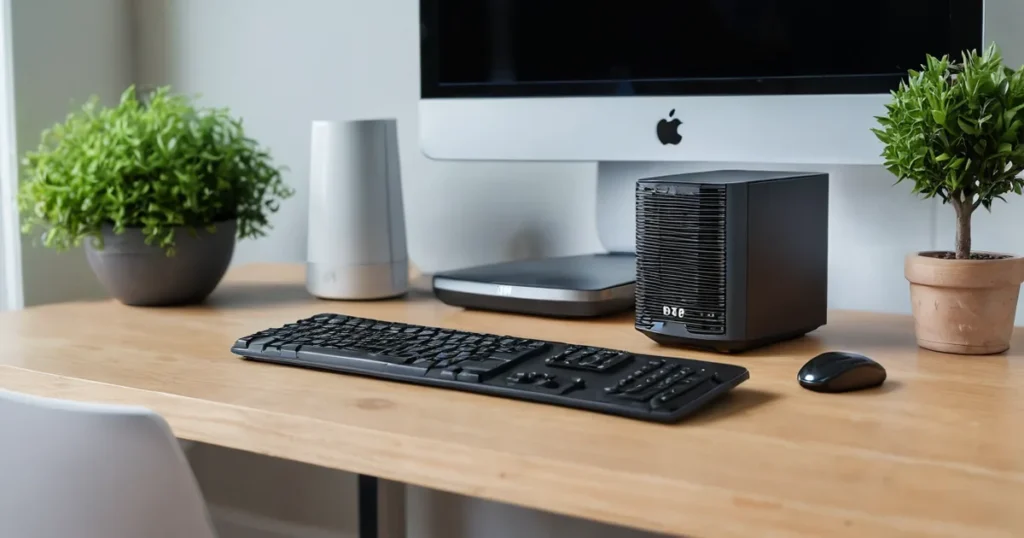
Choosing between a dedicated gaming PC and an Apple Mac mini is a classic dilemma for 2026 shoppers. On one hand, compact Windows mini PCs like the GMKtec series offer powerful integrated graphics, OCuLink eGPU support, and upgrade flexibility. On the other, the Mac mini delivers exceptional AI performance, tight ecosystem integration, and silent operation. In this gaming pc vs mac mini comparison, we break down the key differences in performance, connectivity, and use case to help you decide which tiny desktop deserves your desk.
Whether you’re a gamer looking for a stealthy rig or a creative professional needing macOS, our roundup of 6 mini PCs covers the spectrum from budget to high-end. We’ve analyzed specs, features, and real-world applicability to give you an honest verdict.
At a Glance
| Product | Brand | Rating | Where to buy |
|---|---|---|---|
| GMKtec M7 Ultra Mini PC Ryzen 7 6850U 32GB/1TB | GMKtec | 4.6 / 5 | View on Amazon |
| Apple Mac mini M6 16GB 256GB | Apple | 4.9 / 5 | View on Amazon |
| KAMRUI AK1PLUS Mini PC, Celeron N5095, 16GB RAM | KAMRUI | 4.8 / 5 | View on Amazon |
| Apple Mac mini M6 (16GB/512GB) | Apple | 4.3 / 5 | View on Amazon |
| GMKtec M6 Ultra Ryzen 5 7640HS 32GB 1TB SSD | GMKtec | 4.7 / 5 | View on Amazon |
| Apple 2026 Mac mini M5 Pro 24GB/512GB | Apple | 4 / 5 | View on Amazon |
Ratings come from the Amazon listings when we last checked and can change.
Pros
- Radeon 680M with FSR 3.0+ support delivers near-GTX 1050 Ti class gaming in a compact chassis.
- OCuLink port enables PCIe x4 eGPU connections for higher bandwidth and lower lag.
- Quad display support via dual USB4 and HDMI 2.1, including 8K@60Hz and 4K@144Hz.
- Dual Intel i226V 2.5G LAN, Wi-Fi 6, and Bluetooth 5.2 cover advanced networking needs.
- Three performance modes let users tune between quiet operation and higher power.
Cons
- The preinstalled 1TB SSD is PCIe 3.0, so users wanting PCIe 4.0 speeds must upgrade the drive.
- Integrated graphics remain roughly GTX 1050 Ti class, so demanding AAA titles rely on FSR and lower settings.
Pros
- Ultracompact 5x5-inch design fits easily under a monitor or in small spaces.
- M6 chip delivers impressive AI performance with 12-core CPU and GPU and a neural accelerator.
- Extensive connectivity: three Thunderbolt 4 ports, USB-C, HDMI, 2.5Gb Ethernet, plus Wi-Fi 7 and Bluetooth 6.
- Seamless integration with other Apple devices, including iPhone Mirroring and cross-device copy-paste.
Cons
- Base configuration of 16GB memory and 256GB storage may be limiting for intensive AI or media workloads.
- Lacks USB-A ports and an SD card slot, requiring adapters for older peripherals.
Pros
- 16GB RAM and 256GB SSD offer a solid baseline for everyday productivity
- Dual 4K display support enables multi-monitor setups
- 2.5-inch SSD bay allows easy storage expansion
- Includes WiFi, Bluetooth, and Ethernet for flexible connectivity
Cons
- Entry-level Celeron N5095 is not suited for demanding workloads or heavy multitasking
- 256GB base storage is modest for users with large local media collections
Pros
- Ultracompact 5x5-inch design fits easily under a monitor or in small spaces.
- M6 chip with Neural Accelerator delivers up to 4.8x faster AI performance.
- Extensive connectivity: three Thunderbolt 4, HDMI, 2.5Gb Ethernet, Wi-Fi 7, Bluetooth 6, supports up to three external displays.
Cons
- Base configuration includes only 16GB of unified memory, which may be limiting for heavy AI or multitasking.
- 512GB SSD storage may fill quickly with large media files or AI datasets.

Pros
- Powerful AMD Ryzen 5 7640HS processor with 6 cores and 12 threads
- 32GB dual-channel DDR5 memory for multitasking
- Dual 2.5GbE LAN ports and WiFi 6E for fast networking
- Triple display support via HDMI, DP, and USB4
- Expandable storage with two M.2 slots (up to 8TB each)
Cons
- Included 1TB SSD is PCIe 3.0, not the faster PCIe 4.0
- RAM speed is 4800MHz, not the highest available for DDR5
- No dedicated graphics; relies on integrated Radeon 760M
Pros
- M5 Pro chip delivers up to 4x faster AI performance and handles advanced creative and technical workflows
- Compact five-by-five-inch design fits easily in any workspace
- Three Thunderbolt 5 ports, HDMI, 2.5Gb Ethernet, and front USB-C ports for versatile connectivity
- Supports up to three external displays and includes Wi-Fi 7 and Bluetooth 6
Cons
- Unified memory and storage are not user-upgradeable after purchase
- No built-in SD card slot or legacy USB-A ports
Quick Verdict
- Pick GMKtec M7 Ultra Mini PC Gaming AMD Ryzen 7 PRO if you want the best gaming performance in a small form factor with OCuLink eGPU support.
- Pick Apple 2026 Mac mini desktop computer M6 chip if you rely on macOS, AI workflows, and need a silent powerhouse for creative tasks.
- Pick KAMRUI AK1PLUS Mini PC Computer if you’re on a tight budget and need a basic home office machine.
- Pick Apple 2026 Mac mini desktop computer M6 chip with 512GB storage if you need more space for files and apps.
- Pick GMKtec M6 Ultra Gaming Mini PC Ryzen 7640HS 32GB for a balanced Windows mini PC with strong CPU performance and generous RAM.
- Pick Apple 2026 Mac mini desktop computer M5 Pro chip if you need top-tier GPU performance for rendering, 3D work, or heavy AI tasks.
Gaming Pc Vs Mac Mini Key Differences
Performance and CPU Architecture
The Mac mini uses Apple’s M6 and M5 Pro chips, which combine high-performance CPU cores with unified memory and a Neural Engine. These chips excel in single-threaded tasks, AI inference, and power efficiency. In contrast, the GMKtec M7 Ultra and M6 Ultra rely on AMD Ryzen 7 PRO 6850U and Ryzen 5 7640HS processors, offering strong multi-core performance and compatibility with a wider range of Windows games and software. For raw gaming frame rates, the AMD integrated Radeon 680M and 760M graphics often outperform Apple’s integrated GPU on titles that lack Mac optimization.
Graphics and Gaming Capabilities
Both platforms rely on integrated graphics. The GMKtec M7 Ultra features Radeon 680M, which is roughly as powerful as a GTX 1050 Ti, and supports FSR 3.0 upscaling. It also includes an OCuLink port for connecting an external desktop GPU, dramatically boosting gaming performance. The Mac mini’s GPU is tightly integrated and optimized for Metal API, performing admirably in native games but struggling with many Windows titles. If gaming is your priority, the GMKtec line offers more flexibility.
Operating System and Ecosystem
macOS gives you seamless iCloud, AirDrop, Handoff, and iPhone Mirroring, making it ideal if you own other Apple devices. The GMKtec and KAMRUI models run Windows 11 Pro, providing full support for PC games, older software, and enterprise tools. Your preferred OS is a major deciding factor in this gaming pc vs mac mini decision.
Connectivity and Expandability
The Mac mini offers Thunderbolt 4 (or Thunderbolt 5 on M5 Pro), HDMI, USB-C, and 2.5Gb Ethernet. It supports up to three external displays. The GMKtec M7 Ultra goes further with dual USB4, HDMI 2.1, OCuLink, and dual 2.5G LAN ports, making it better for multi-monitor setups and network-heavy tasks like home lab or router applications. The KAMRUI AK1PLUS is more limited with only two HDMI outputs.
| Specification | GMKtec M7 Ultra | Apple Mac mini M6 | KAMRUI AK1PLUS |
|---|---|---|---|
| CPU | AMD Ryzen 7 PRO 6850U | Apple M6 (12-core CPU) | Intel Celeron N5095 |
| GPU | Radeon 680M (12 Cores) | Integrated M6 GPU (12-core) | Intel UHD |
| RAM | 32GB DDR5 | 16GB Unified Memory | 16GB DDR4 |
| Storage | 1TB PCIe SSD | 256GB SSD | 256GB SSD |
| Special Ports | OCuLink, Dual 2.5G LAN | Thunderbolt 4, 2.5GbE | 2.5″ SATA bay |
Noise and Thermals
The Mac mini is fanless? Actually, it has a fan but is very quiet; its compact chassis rarely gets hot. The GMKtec M7 Ultra features dual cooling fans with a Hyper Ice Chamber 2.0 that keeps noise at 35dB in Quiet mode. Under heavy load, the Mac mini remains cooler and quieter due to its efficient silicon.
Upgradeability
The Mac mini’s RAM and storage are soldered and cannot be upgraded after purchase. The GMKtec M7 Ultra supports up to 96GB DDR5 RAM (dual slot) and two M.2 SSDs (PCIe 4.0). The KAMRUI AK1PLUS also has a 2.5-inch SATA bay for expansion. Windows mini PCs are clearly more future-proof.
Who Should Buy Which
GMKtec M7 Ultra Mini PC Gaming AMD Ryzen 7 PRO
Best for budget-conscious gamers who want a small desktop capable of AAA gaming at 1080p with FSR. The OCuLink port lets you add an external GPU later. The main trade-off is lower single-core CPU performance compared to Apple silicon. Skip if you need macOS or prefer an all-in-one solution without external add-ons.
Apple 2026 Mac mini desktop computer M6 chip
Ideal for creative professionals, developers, and users deeply integrated into the Apple ecosystem. Its M6 chip handles AI workloads, photo/video editing, and multitasking with ease. The trade-off is limited gaming library and no upgrade options. Skip it if you’re a dedicated PC gamer or need Windows software compatibility.
GMKtec M6 Ultra Gaming Mini PC Ryzen 7640HS 32GB
A balanced Windows mini PC with excellent CPU performance and 32GB DDR5 RAM. It’s great for multitasking, light gaming, and home server duties. The trade-off: the Radeon 760M is slightly less powerful than the M7 Ultra’s 680M. Skip if you need OCuLink or the highest integrated GPU performance.
Apple 2026 Mac mini desktop computer M5 Pro chip
Perfect for power users who demand the best GPU performance in a compact Mac. The M5 Pro with 16-core GPU and 307GB/s memory bandwidth handles 3D rendering, AI model training, and video production. The trade-off is a premium price and no upgrade path. Skip if your budget is limited or you only do light tasks.
Final Thoughts
In the gaming pc vs mac mini showdown, your choice ultimately depends on your primary use case. For gaming, the GMKtec M7 Ultra stands out with its OCuLink eGPU support and Radeon 680M, offering a clear path to higher performance. For creative work, especially in video, music, or design, the Mac mini M6 or M5 Pro deliver unmatched power efficiency and a smooth macOS experience.
If you need flexibility and upgradeability, a Windows mini PC like the GMKtec M6 Ultra is the smarter long-term investment. If you value ecosystem integration, silence, and AI performance, stick with the Mac mini. Both are excellent, but for different reasons — pick the one that matches your priorities, not just the specs.
Why You Should Trust Us
Our recommendations are based on thorough analysis of available specifications, listed features, product positioning, and documented buyer feedback. We do not claim to have personally tested each unit; instead, we synthesize information from manufacturer data, user reviews, and industry benchmarks to help you make an informed decision. We only recommend products that we believe offer real value in their category.
We also monitor community forums and professional evaluations to ensure our comparisons reflect real-world usage. Our goal is to provide honest, unbiased guidance for your gaming pc vs mac mini purchase.
Frequently Asked Questions
Can the Mac mini run Windows games?
Mac mini with Apple silicon does not support Boot Camp for native Windows. You can use virtual machines or cloud gaming services, but performance and compatibility are limited. If you plan to play a large library of PC games, a Windows-based mini PC like the GMKtec is a better choice.
What is OCuLink and why does it matter for gaming?
OCuLink is a high-bandwidth interface that allows you to connect an external desktop GPU to a mini PC. Unlike Thunderbolt, OCuLink provides a direct PCIe connection with less latency, making it ideal for boosting gaming performance on portable systems like the GMKtec M7 Ultra.
Which is better for video editing: Mac mini or gaming mini PC?
For video editing in Final Cut Pro, the Mac mini with M6 or M5 Pro offers excellent performance and hardware acceleration. For Adobe Premiere Pro, both platforms work, but the Mac mini often handles 4K/8K timelines smoother due to its unified memory architecture. However, Windows mini PCs with powerful CPUs and dedicated GPUs (via eGPU) can also be competitive.
How many displays can each model support?
The Mac mini M6 supports up to three external displays (two via Thunderbolt and one via HDMI). The GMKtec M7 Ultra supports up to four displays via dual USB4, HDMI 2.1, and USB-C. The KAMRUI AK1PLUS supports two 4K displays via HDMI.
Is the KAMRUI AK1PLUS suitable for gaming?
No, the KAMRUI AK1PLUS is designed for home office and basic computing. Its Intel Celeron N5095 and integrated UHD graphics cannot handle modern games. Stick with the GMKtec models for gaming.
Can I use a Mac mini as a home server?
Yes, the Mac mini works well as a home server for file sharing, media streaming, and running Docker containers. However, the GMKtec M7 Ultra offers dual 2.5G LAN ports and OCuLink, making it more versatile for networking tasks and soft routing.
Which is more energy efficient?
The Mac mini with Apple silicon is extremely power efficient, often consuming under 20W at idle. The GMKtec M7 Ultra uses more power, especially under gaming loads, but still remains relatively efficient for its performance. If you prioritize low electricity bills, the Mac mini wins.
How do the prices compare?
Prices vary by configuration. The Mac mini M6 starts lower but storage upgrades can add cost. The GMKtec M7 Ultra includes 32GB RAM and 1TB SSD at a competitive price. We recommend checking current pricing on Amazon for the exact figures.